
OurStrategy
The anti-aging market is poised to become the next market worth tens of trillions of yen.
However, at its core lies an area that no one has yet seriously set out to tap into.
We will take on this challenge as the company that takes the first step in that direction.

The anti-aging industry is
the next mega-market
The longevity market is already large and growing rapidly.
It is expanding beyond mere anti-aging to become an industry focused on extending healthy life expectancy.
I believe this is not a passing fad, but an unstoppable structural shift.
10 to 20 trillion yen
Annual average growth rate of 6–10% Driven by demand for beauty, wellness, and anti-aging9trillion yen → 35trillion yen
An average annual growth rate of 20% or more Shifting from Post-Treatment Care to Prevention and Extensionapprox.270 trillion yen
A massive issue that affects society as a whole Covering everything from medical care and prevention to wellness and life planningFrom “Treating diseases ”
to “Controlling aging ”
In the past, the focus was on “symptomatic treatment,” which involved treating diseases such as cancer, diabetes, and dementia individually. Going forward, by viewing aging as a “common cause,” there is the potential to develop treatments that work across multiple diseases—in other words, treatments that can intervene in the aging process. A shift from the traditional approach of “treating individual diseases” to the concept of “intervening in aging as a common factor.” It is precisely this dynamism that we intend to harness.
Bold Hypotheses and Conviction.
A Challenge in Drug Discovery Made Possible by U-Factor®
Drug discovery using stem cell culture supernatant is
an area that major pharmaceutical companies find difficult to approach
Stem cell supernatant contains thousands of factors that interact in complex ways, and—much like traditional Chinese medicine—it is difficult for modern science to identify a single active ingredient. Since regulatory approval requires a clear explanation of the mechanism of action, this is an area that cannot be addressed using existing drug discovery workflows. The larger the organization, the more cautious it must be in the face of such uncertainty.
Collaborating with Clinics this is a challenge only we could take on
We chose to address that uncertainty by formulating hypotheses. We identified signs of efficacy through clinical observations in self-pay treatments and then worked to elucidate “why it works” through retrospective analysis—an approach we were able to take precisely because we are a startup.
U-Factor® is the only company
aiming to develop new drugs using
stem cell culture supernatant
We are conducting joint research
with multiple universities and
national research institutes
The manufacturing site is
located in Edogawa Ward, Tokyo,
at Daiichi Sankyo’s facility
U-Factor® is the only company
conducting specified clinical research registered with the Ministry of Health, Labor and Welfare
using stem cell supernatant.
An Unprecedented
Business Model for Drug Discovery Startups
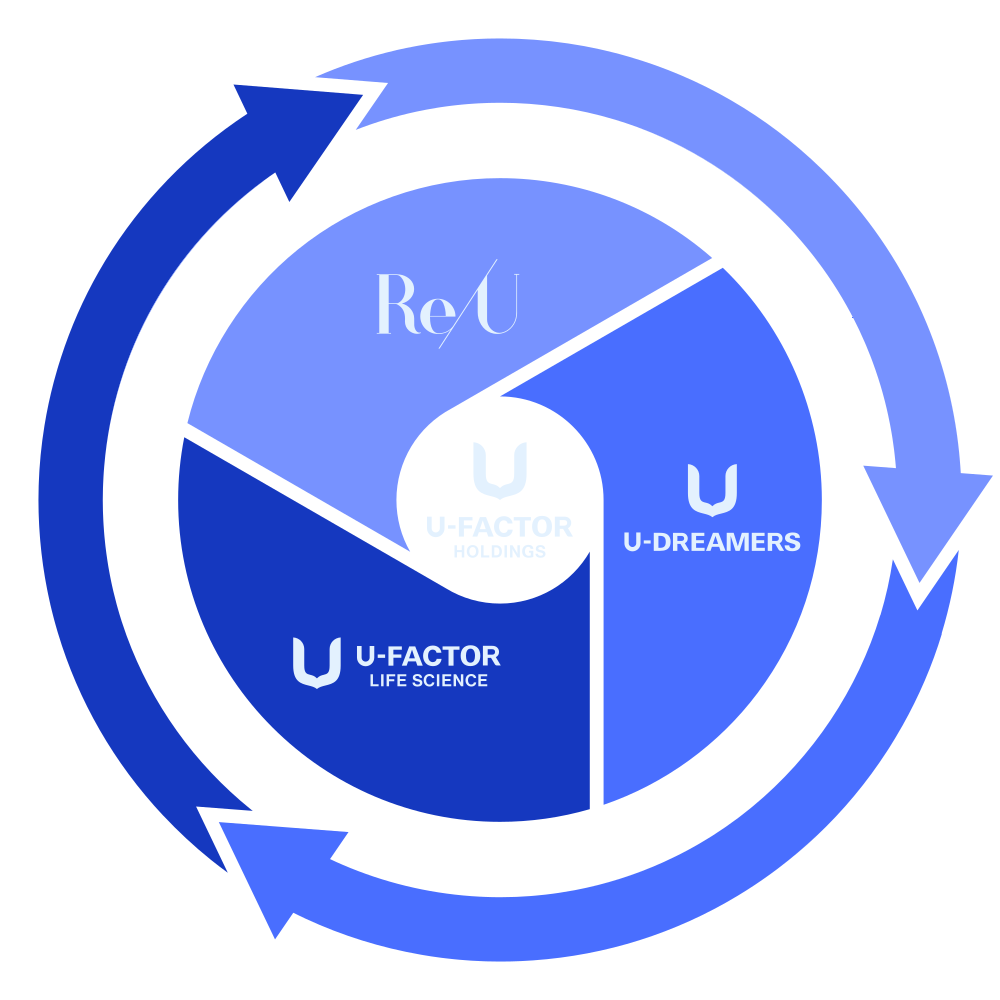 Commercialization Sales Reinvestment
 Without relying on external funding
Expanding research and development
Typical drug discovery startups operate under a business model in which they continue development while operating at a loss, eventually selling their know-how and intellectual property to pharmaceutical companies. At U-Factor®, we reinvest the revenue generated from supernatant-based products—such as cosmetics—into drug discovery and development, enabling high profit margins and early profitability. This is a unique business model that allows us to maintain stable operations without relying on external funding while developing multiple pipelines using supernatants that are expected to be effective against a wide range of diseases.